The oldest and largest public university in Bosnia and Herzegovina, founded in 1949, with Medicine, Dental Medicine, Business and Data Science taught in English in Sarajevo.
Overview
The key facts about this university at a glance.
Tuition
€6,135 / year (Medicine, Dental Medicine in English), €2,045 / year (Financial and Marketing Management), €1,534 / year (Data Science and AI), other programmes on request
Degrees
Doctor of Medicine, Doctor of Dental Medicine, Bachelor, Master, PhD
Language
English (Medicine, Dental Medicine, Business, Data Science and AI) and Bosnian, Croatian and Serbian
Programmes
Medicine (English), Dental Medicine (English), Business and Management (English), Data Science and Artificial Intelligence (English), Pharmacy, Veterinary Medicine, Health Studies, Engineering, Law, Social Sciences, Humanities, Natural Sciences, Arts
Duration
6 years (Medicine, Dental Medicine), 5 years (Pharmacy, Veterinary Medicine), 3 to 4 years (Bachelor), 1 to 2 years (Master)
Intake
October
Living costs
approx. €450 to 650 per month
Admission
School-leaving certificate with nostrification, English proficiency for English programmes
About the university
The University of Sarajevo (Univerzitet u Sarajevu, UNSA) is the oldest and largest public university in Bosnia and Herzegovina. It was formally established in 1949, although its oldest roots go back to the Ottoman schools of the 16th century. Today it brings together 22 faculties, three academies and several research institutes, with about 22,000 students and a first-year intake of more than 5,700 places for 2026/27. For international students the key offer is a group of programmes taught entirely in English: the six-year International Medical Degree Program (Medicine in English, 360 ECTS) at the Faculty of Medicine, the six-year integrated Dental Medicine in English at the Faculty of Dentistry, the three-year bachelor Financial and Marketing Management and the Business Studies programme with Griffith College Dublin at the School of Economics and Business, and the three-year bachelor Data Science and Artificial Intelligence at the Faculty of Electrical Engineering.
Tuition for Medicine in English and Dental Medicine in English is 12,000 KM per year, which is about €6,135. The English business bachelor costs about €2,045 a year for international students and Data Science and Artificial Intelligence about €1,534 a year. Clinical teaching for medicine takes place at the Clinical Center of the University of Sarajevo (KCUS) on the Koševo hill, the largest hospital in the country, and the Faculty of Dentistry runs its own Dental Clinical Centre with six specialist clinics.
Most faculties sit in central Sarajevo. The University Campus on Zmaja od Bosne street, near Marijin Dvor, houses the Faculty of Electrical Engineering, the Faculty of Pharmacy, the Faculty of Science, the Faculty of Transport and Communications and several others. The medical faculties are grouped around Čekaluša and Bolnička streets, a short walk from the teaching hospital. The Rectorate stands on the Miljacka riverbank at Obala Kulina bana 7.
We at Study in Bosnia help you with the whole process: choosing the right programme, preparing documents and nostrification, the application itself, then housing, the student visa and the residence permit through our local office in Bosnia and Herzegovina.
At a glance
Study programmes
Medicine in English (International Medical Degree Program, IMDP) – Faculty of Medicine. Integrated first- and second-cycle study, 6 years, 360 ECTS, leading to the title Doctor of Medicine. The Faculty admits 30 students per year to the IMDP regardless of citizenship. Preclinical subjects are taught in the faculty building on Čekaluša, clinical rotations run at the Clinical Center of the University of Sarajevo. Tuition is 12,000 KM (about €6,135) per year, payable in two instalments of 6,000 KM.
Dental Medicine in English – Faculty of Dentistry with Dental Clinical Centre. Integrated study, 6 years, 360 ECTS, leading to the title Doctor of Dental Medicine. A small group of ten places per year means close contact with teachers and early practical work in the faculty's own clinics. Tuition is 12,000 KM (about €6,135), payable in full or in two instalments.
Financial and Marketing Management – School of Economics and Business (SEBS). Bachelor, 3 years, 180 ECTS including an internship and a bachelor thesis, title Bachelor of Management. After a common first year you choose the Financial Management or the Marketing Management concentration. The programme holds international business-school accreditation. International students pay 4,000 KM (about €2,045) per year.
Business Studies with Griffith College Dublin – School of Economics and Business. Bachelor, 3 years. The first two years are taught in Sarajevo, the third in Dublin, and graduates receive two diplomas. Tuition is about €5,000 per year in Sarajevo and about €6,000 for the final year in Dublin.
Data Science and Artificial Intelligence (DSAI) – Faculty of Electrical Engineering. Bachelor of Engineering, 3 years, fully in English, no knowledge of the local language needed. Courses cover programming in Python, statistics, machine learning and data engineering. The programme runs on campus and as distance learning. Tuition is 3,000 KM (about €1,534) per year.
English-taught master programmes – School of Economics and Business: Management with Financial Management and Banking in English (2 years, 120 ECTS), Marketing in English, and an MBA run jointly with the Faculty of Economics of the University of Ljubljana (2 years, 120 ECTS).
All bachelor programmes last 4 years (240 ECTS). One-year master programmes in Physiotherapy, Laboratory Technologies, Radiological Technologies, Sanitary Engineering and Nursing, plus a doctorate in health sciences.
Bachelor 3 years (180 ECTS); master programmes in the same four fields plus Information Security; doctoral study.
Nine master programmes, among them Production Technologies, Automation and Robotics, plus a joint master in Sustainable Business and Innovation with the School of Economics and Business.
Master with tracks in Structures, Hydraulic and Environmental Engineering, Roads and Geotechnics, and in Geodesy and Geoinformatics.
Master programmes include International Economics and European Integration, Money and Finance, Advanced IT Management and Innovation, Business Analytics, Accounting and Auditing, Management and Information Systems with Microsoft, Forensic Accounting and Supply Chain Management; doctoral study in Business Economics (3 years, 180 ECTS).
Master tracks: Gender and Law, Criminal Law, Law and Economics, Arbitration and Alternative Dispute Resolution, Comparative Law.
Master programmes include Crisis Management in the Security Sector and Corporate Security.
Most fields can be studied as a single subject or in combination with a second subject; master programmes in all departments, including a double-degree master in Applied Intercultural Philology.
Sixteen master programmes, from Phytomedicine and Urban Agriculture to Viticulture and Oenology and Aquaculture.
Master in Sustainable Management of Forest Ecosystems and in Landscape Architecture.
Master programmes in Administration, Business Administration, Public Procurement, EU Project Management and Public Governance and Business Administration.
The university also runs interdisciplinary master programmes through its Centre for Interdisciplinary Studies, including the European Regional Master in Democracy and Human Rights in South-East Europe, One Health, International and Regional Security, and Law and Digital Technologies. Doctoral studies exist at almost every faculty.
Faculties and campus

The Faculty of Medicine is the first medical school in Bosnia and Herzegovina and celebrates its 80th year in 2026. It helped to found the other medical faculties of the country. Its building stands on Čekaluša street on the slope above the city centre, about ten minutes on foot from the Clinical Center of the University of Sarajevo. More than 9,500 doctors have graduated here.
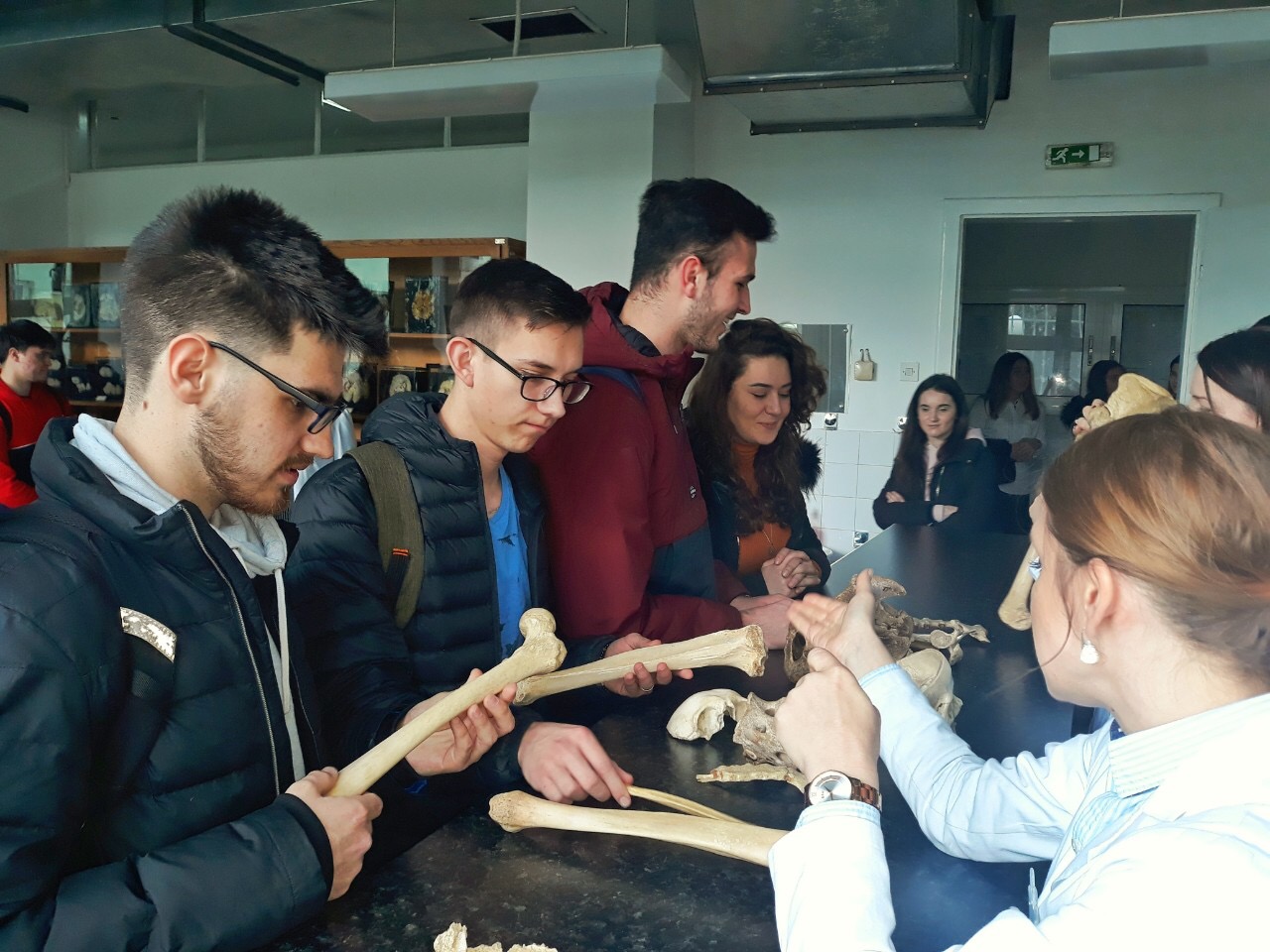
Preclinical teaching uses the faculty's own departments of anatomy, physiology, pathology, microbiology and pharmacology, a genetics centre and a digital anatomy atlas. Clinical years move to the Koševo clinics. The Faculty was also the first in the country to offer medicine in English, and today the IMDP runs side by side with the local-language programme.
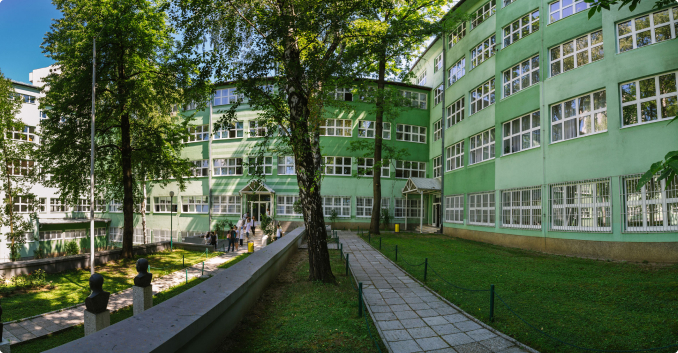

Dental education in Sarajevo started in 1960 as a department of the Faculty of Medicine, and it became the first dental faculty in Bosnia and Herzegovina. The building on Bolnička street sits right next to the hospital quarter. Students train in the faculty's own Dental Clinical Centre.
The Faculty of Pharmacy has trained pharmacists for about five decades. It is based on the University Campus and organises its teaching in ten departments, from pharmaceutical chemistry and drug analysis to toxicology and pharmaceutical biochemistry. The five-year integrated programme is followed by specialisations and a doctorate.

The Faculty of Veterinary Medicine has a history of more than 75 years. It runs a Veterinary Clinical Centre for small and large animals, accredited testing laboratories, a food control centre and the Veterinary Institute at Stup. An anatomical museum belongs to the faculty as well.


The Faculty of Health Studies trains physiotherapists, nurses, midwives, radiology and laboratory technologists, sanitary engineers and dietitians. Its building was fully reconstructed and newly equipped in a four-year investment project and reopened in February 2025. The seven four-year bachelor programmes are all practice-oriented and closely linked to the clinics of Sarajevo.

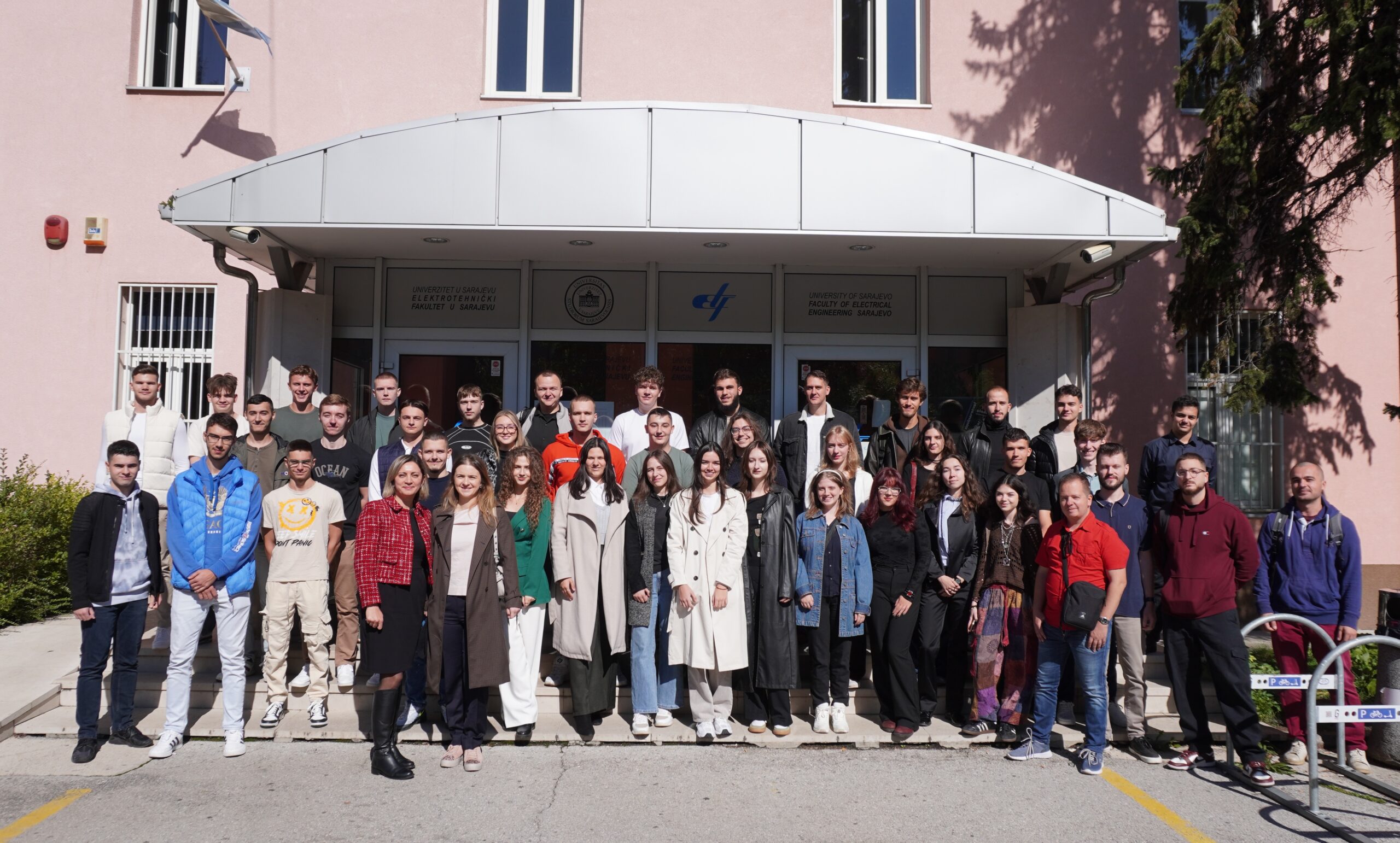
Founded in 1961, the Faculty of Electrical Engineering (ETF) is the oldest and largest school of its kind in Bosnia and Herzegovina. It has four departments: Automatic Control and Electronics, Power Engineering, Computer Science and Informatics, and Telecommunications. Its laboratory complexes cover electrical machines, high voltage, software development, electronics and telecommunications.
The faculty publishes about 150 scientific papers a year and runs more than 20 research projects. Since 2024 it offers the English-taught bachelor Data Science and Artificial Intelligence, developed with support from Norway and UNDP.
The Faculty of Mechanical Engineering on the campus is the largest engineering faculty after the ETF, with nine bachelor programmes from energy and vehicles to wood technology and defence technologies. The Faculty of Civil Engineering and the Faculty of Architecture share the building at Patriotske lige 30, a few minutes from the campus. Architecture has been taught in Sarajevo since 1949 and runs its own Institute for Architecture, Urbanism and Spatial Planning.
The Faculty of Transport and Communications (Zmaja od Bosne 8) covers road, rail and air transport, postal logistics and communication technologies. It is a Cisco Networking Academy partner.
Founded in 1952, the School of Economics and Business (SEBS) is the oldest and largest business school in the country. It holds two international business-school accreditations, one of them for the English bachelor Financial and Marketing Management. The modern building stands on the square next to the Faculty of Law and the National Theatre area, about 15 minutes on foot from Baščaršija.
SEBS has more than 30 exchange partners and runs joint programmes with Griffith College Dublin, the University of Ljubljana and the University of Osijek. Each year about 80 of its students go abroad on exchange.
The Faculty of Law, founded in 1946, stands on the Miljacka embankment at Obala Kulina bana 7, next to the Rectorate. The Faculty of Political Science offers political science, international relations, journalism, sociology, social work and security and peace studies. The Faculty of Criminalistics, Criminology and Security Studies completes this group.

The Faculty of Science became independent from the Faculty of Philosophy in 1960. Its five departments are Biology, Physics, Geography, Chemistry, and Mathematical and Computer Sciences. Computer Science alone admits 85 first-year students.
The Faculty of Philosophy is the largest humanities faculty in the country, with 14 departments and a chair of art history. Languages are its strength. Students can study English, German, French, Italian, Russian, Arabic, Turkish and Persian, alongside history, psychology, pedagogy and philosophy.
Agriculture and forestry were taught together from 1940 and split into two faculties in 1959. The Faculty of Agriculture and Food Science runs an experimental field and a gene bank at Butmir. Forestry covers forest management and horticulture.
The Faculty of Sport and Physical Education trains kinesiologists and sport managers. The Faculty of Educational Sciences prepares preschool and primary school teachers and special education professionals. The Faculty of Administration is an associate member of the university. The Faculty of Islamic Studies and the Faculty of Catholic Theology offer theology and religious education, and together with the Orthodox theology faculty in Foča they run a master in interreligious studies.
The Academy of Fine Arts, founded in 1972, has worked since 1981 in the former Evangelical church on the Miljacka, a Romanesque-Byzantine building from 1899. The Music Academy at Josipa Štadlera 1 and the Academy of Performing Arts, whose students regularly win awards at regional film festivals, complete the arts group.

The Rectorate and the International Relations Office are at Obala Kulina bana 7. The University Campus on Zmaja od Bosne, a former military complex, now holds a dozen faculties, green areas and sports grounds, and the university is building a new University Library there.
Admission
Your application to the University of Sarajevo goes through us. As an authorised partner of Bosnian universities, Study in Bosnia has contracts with the individual universities and a fixed quota of places per programme and year. We allocate these places on a first-come, first-served basis, provided you meet certain minimum criteria and the visa and entry requirements.
We handle the entire admission for you. We check your eligibility for the programme you want, organise certified translations and start the nostrification with the Cantonal Ministry of Education in Sarajevo. Then we submit your complete application to the faculty as its authorised partner and stay in contact with the student services office until you are enrolled.
After admission our local team in Sarajevo helps you with the student visa, the first registration of your address and the residence permit, and we look for a room or flat near your faculty. Bring originals with you. Several offices will want to see them.
Tuition and living costs
One-off costs are small. You pay an application fee, small enrolment and information-system fees, the translation and nostrification of your school documents, the medical certificate, and the residence permit fee. Budget a few hundred euros in the first months.
Most of our students live on €450 to 650 a month in total.
Our estimate for Medicine or Dental Medicine in English: tuition 6 × €6,135 = €36,810, plus living costs of €550 × 12 × 6 = €39,600, gives about €76,400 for the complete six-year degree.
Our estimate for Financial and Marketing Management: 3 × €2,045 = €6,135 in tuition plus €550 × 12 × 3 = €19,800 in living costs, about €26,000 for the whole bachelor.
Our estimate for Data Science and Artificial Intelligence: 3 × €1,534 = €4,602 in tuition plus €19,800 in living costs, about €24,400 for the whole bachelor.
These are estimates based on a mid-range budget. Shared flats and cooking at home bring the numbers down noticeably.
City and student life
Sarajevo is the capital of Bosnia and Herzegovina and the country's largest student city. Around 22,000 students study at the University of Sarajevo alone, and you feel it in the cafés of Ferhadija and Marijin Dvor every evening. The city stretches for about ten kilometres along the Miljacka valley, so almost everything lies on one long east–west axis.
The University Campus sits on Zmaja od Bosne, the main avenue. Tram line 3 runs from Ilidža past the campus and the Marijin Dvor stop to Baščaršija, the Ottoman old town, in about fifteen minutes. Medical and dental students mostly live around Koševo, Ciglane and Breka, the quiet residential districts around the Clinical Center. From Čekaluša you walk downhill to the old town in about twenty minutes. We usually advise students of medicine to look for rooms in Koševo or Ciglane because the faculty, the dental clinics and the hospital are all within walking distance. Engineering and science students prefer Grbavica, Marijin Dvor and Hrasno, which are flat and well served by trams and trolleybuses.
The airport lies about 12 km west of the centre. Direct flights connect Sarajevo with Vienna, Istanbul, Frankfurt, Zurich and several low-cost destinations. The train to Mostar takes about two hours through the Neretva canyon. By bus, Dubrovnik and the Adriatic coast are about five hours away, Belgrade about six and Zagreb about seven.
The climate is continental. Summers are warm and dry, often around 28 °C, while winters bring snow and cold mornings. Good shoes help. The mountains Bjelašnica and Jahorina, venues of the 1984 Winter Olympics, are less than an hour away and offer affordable skiing; in summer the same slopes are full of hikers.
Daily life is good value. A portion of ćevapi costs about €4, a coffee in the old town about €1.50, and a lunch menu near the campus €5 to 7. Sarajevo is a safe city with a relaxed, sociable rhythm, and people are used to international students and visitors. Many speak English well.
Culture fills the calendar: the Sarajevo Film Festival in August, the jazz festival in November, the winter festival and countless concerts at the National Theatre and the academies. Compared with smaller university towns such as Foča or Banja Luka, Sarajevo gives you capital-city life, embassies, international organisations and many part-time and internship options, while rents remain moderate. Our local office knows the neighbourhoods well and helps you find a place before you arrive.
How we support you
One team for everything, with our head office in Bern and our local office in Bosnia and Herzegovina.
We look at your school certificate, your goals and your budget and tell you which programme fits you best.
Translations, nostrification of your certificate and the complete application, submitted on time.
We prepare your visa file and accompany you to the authorities for your residence permit.
A flat or a room in a shared flat, and our local team is there when you arrive.
FAQ
Yes. The Faculty of Medicine of the University of Sarajevo offers the International Medical Degree Program, a six-year integrated programme taught entirely in English with 360 ECTS and the title Doctor of Medicine. Thirty places are available each year regardless of nationality. Clinical training takes place at the Clinical Center of the University of Sarajevo in Koševo. We help you prepare the application and documents.
Tuition for the International Medical Degree Program at the University of Sarajevo is 12,000 KM per year, which is about €6,135. You can pay it in two instalments of 6,000 KM before each semester. Living costs in Sarajevo add about €450 to 650 per month. Our estimate for the whole six-year degree including living costs is roughly €76,400.
Yes. The Faculty of Dentistry with Dental Clinical Centre of the University of Sarajevo offers integrated Dental Medicine in English, six years and 360 ECTS. Only ten places are offered per year, so groups are small. Tuition is 12,000 KM, about €6,135. Practical training takes place in the faculty's own six specialist clinics on Bolnička street.
The University of Sarajevo offers three English-taught bachelor programmes: Financial and Marketing Management and Business Studies with Griffith College Dublin at the School of Economics and Business, and Data Science and Artificial Intelligence at the Faculty of Electrical Engineering. All three last three years. Tuition ranges from about €1,534 to €5,000 per year.
Yes. The University of Sarajevo is a public, state-accredited university founded by Sarajevo Canton. Established in 1949, it is the oldest and largest university in Bosnia and Herzegovina, with 22 faculties, three academies and about 22,000 students. Its degrees are issued by a public institution, and it takes part in Erasmus+ and the European university alliance EUPeace.
The University of Sarajevo has several locations in central Sarajevo. The main University Campus is on Zmaja od Bosne street near Marijin Dvor, served by tram line 3. The Faculty of Medicine is on Čekaluša 90 and the Faculty of Dentistry on Bolnička 4a, both close to the Koševo hospital. The Rectorate is at Obala Kulina bana 7 on the river.
Medical students of the University of Sarajevo train at the Clinical Center of the University of Sarajevo (KCUS) on the Koševo hill, the largest hospital in Bosnia and Herzegovina with dozens of clinics. It is about ten minutes on foot from the Faculty of Medicine. Dental students work in the Dental Clinical Centre run by the Faculty of Dentistry itself.
Yes. For students of the University of Sarajevo we handle translations, nostrification and the complete application, and then organise housing, the student visa and the residence permit. Our local office in Bosnia and Herzegovina searches rooms in shared flats or apartments near your faculty, for example in Koševo for medical students or Marijin Dvor for campus faculties.
At the University of Sarajevo the winter semester starts in early October; for 2026/27 bachelor and integrated programmes began on 5 October 2026. The summer semester starts at the beginning of March. Each semester has fifteen weeks of teaching followed by an exam period. We recommend arriving in September to finish registration and settle into your flat.
Study in Bosnia
Study in Bosnia is the official representative of Bosnian universities. We help you from your study place to housing, visa and residence permit.
30 minutes, free and without obligation.